Friday, November 8, 2013

Eight Great Telescopes That Aren't Hubble

The Hubble Space Telescope has successfully become the most famous telescope in the world. It has maintained this popularity through many years of operation, repeated news events surrounding the telescope, and promotion through sharing its imagery with the public through various venues on the internet. It's so well known that any time an average member of the public sees a detailed astrophoto they're more likely than not to ask if it's a Hubble image.

But Hubble isn't the only great telescope out there. In fact, while it is still a very valuable instrument contributing much to current science, its capabilities have in many ways been eclipsed by other instruments. After all, the Hubble was conceived and designed when an Apple II computer, running at 1MHz with an 8 bit processor and about 128KB of RAM was a serious work computer. So, while we recognize and accept the greatness of Hubble, let's have a look at some other telescopes that have been eclipsed by its popularity.

The Chandra X-Ray Observatory

Chandra X Ray Observatory Satellite
The Chandra X-Ray Observatory was one of Hubble's sister scopes in NASA's Great Observatories program. While Hubble was designed to cover the visual and near-infrared part of the electromagnetic spectrum, Chandra covers X-Rays. One of the great advantages of Hubble was that it was outside the atmosphere, eliminating the effects of the air on its images. In Chandra's case, getting outside the atmosphere is critical, x-rays don't penetrate our atmosphere to any degree. A ground-based x-ray telescope would be blind.

Despite coming from the same overall program as Hubble, the Chandra has gotten far less notoriety. Its images are no less beautiful, and are arguably more scientifically valuable since much of what Hubble does could be reproduced with other instruments. The same can't be said of Chandra.

The Spitzer Space Telescope

Spitzer against an infrared sky in space
Spitzer was also part of the Great Observatories program. It is the full-featured infrared complement to Hubble. Infrared is another part of the electromagnetic spectrum that is interfered with by the atmosphere far more than visual light. High altitude observatories can get above enough of the atmosphere to do IR observation from the ground, but getting into space is far better.

Infrared observations are especially important compared to visual light because IR wavelengths penetrate gas and dust better than visual wavelengths. On top of that, the effects of red-shift--light being shifted to lower frequencies by the expansion of the universe--means that to observe the visual light emissions of far away objects in space we need to look for infrared light here. It's been red-shifted out of the visual light spectrum entirely. Observations of the early universe rely on IR telescopes. This is why the new large space telescope, the Keck, often hailed as "Hubble's replacement", is being designed to work in IR wavelengths.

Aside from its scientific value, Spitzer also produces images of great beauty and wonder. Like Chandra, it has lived in Hubble's shadow for over ten years now.

The Great Observatories were originally rounded out by the Compton Gamma Ray Observatory. Its stabilization systems broke down after years of operation, and it was brought back down into the atmosphere for destructive re-entry. The remaining Great Observatories are still working today to produce valuable new science.

Fermi Gamma Ray Telescope

Fermi satellite image, a box with wings.
Fermi is the successor and advancement over the Compton Gamma Ray Telescope. Like the Compton, it is an orbital telescope. It observes the highest energies of radiation in the electromagnetic spectrum. It's been in operation for over five years as of the time I write this, and is extending its mission time in space. We hear about Hubble all the time, but this telescope has been working away in space, revolutionizing science for five years. Have you heard of it? (If you read a lot of astronomy magazines and journals like I do, you almost certainly have--if you get information from less specialized sources, you've could easily have missed it or forgotten about it even if you saw a short segment on it somewhere.)

Fermi was originally called GLAST after its main instrument, the Gamma ray Large Area Space Telescope. Once again, this telescope is designed to see things that Hubble can't see. Rather than looking as small, specific parts of the sky it scans the entire sky every three hours. It is used to image particles that are travelling just under the speed of light, the most energetic particles in the universe. This allows us to study physics in ways that we can't reproduce in laboratories on Earth. You think the Large Hadron Collider is powerful? The physics powerhouses that Fermi studies make LHC look like a pop-gun!

Large Binocular Telescope

large binocular telescope with doors open, showing dual telescopes inside.
Before Hubble, the Palomar Hale Telescope got all the press. It was the "200 inch telescope", the biggest in the world for a long time. Even after the Bolshoi Telescope was built, many Americans (at least) still thought Palomar was the largest. (Though the Bolshoi has always had problems that kept it from having the best performance. However, it is still used and is being upgraded again.

Today, the relatively unknown Large Binocular Telescope sports a pair of mirrors, each 331 inches in diameter! That means each mirror has over 2.7 times the light collecting area of Palomar's Hale telescope. Together, it's about five and a half times the light collecting area. But, as they say in the commercials, that's not all.

The Large Binocular Telescope uses adaptive optics (AO). This is a means of flexing the optical surfaces of the telescope to get the best possible image. The adaptation happens in real time, allowing the telescope to eliminate much of the problems from observing from the ground, rather than in space. In essence, if we'd had working adaptive optics back when Hubble was being designed, we would have already had ground-based telescopes that can see as well or better than Hubble! If we'd gone ahead with launching a telescope into space (still a good idea), then we would have had to build a telescope even more amazing than Hubble to justify the extra cost and effort (Hubble cost as much or more than a huge ground-based observatory project.)

But, reality is that we pulled together all the parts to build adaptive optics into ground based observatories after the commitment had already been made to Hubble. So now we have many ground based observatories that can out-perform Hubble, the Large Binocular Telescope among them.

The South African Large Telescope

SALT Observatory in daytime
The South African Large Telescope is the largest telescope in the southern hemisphere. Now, space telescopes like Hubble, Fermi, Spitzer, and Chandra don't care about hemispheres, but here on Earth you can only see so much of the sky from any place on Earth. It has roughly four times the light collecting area of Palomar's 200 inch (5.1m) Hale telescope. Its main mirror is a segmented mirror. Whereas the LBT has two mirrors that work side by side as two optical trains, the SALT telescope has 91 individual mirrors that all work together to form one big mirror, creating a single image. The mirrors are all made to work together through careful alignment using laser calibration. Also, rather than tracking the sky like other telescopes, the telescope stays fixed in place, while the instruments attached to the telescope track to capture the light from the object being observed.

The Magellan Telescopes

The Magellan Telescope buildings at night, lit by ambient light
Image by Krzysztof Ulaczyk
The Magellan Telescopes are a pair of telescopes that each use a single 6.5 meter mirror. They can work together, like the telescopes in the LBT, or they can work independently. Their large reflecting surfaces are made up of a single mirror, rather than a lot of smaller mirrors put together to act as a single mirror, like SALT. The mirrors are not a single large thick slab, like the Palomar Hale Telescope, however. They have hollows inside, they've got a honeycomb-like structure inside that supports the reflecting surface without being solid. Each mirror has well over 1.5 times the light collecting area of the Hale telescope, and, like the LBT, they are equipped with adaptive optics to clean up the image.

The Keck Observatory

The twin Keck Telescope Domes
Hubble's launch ended up being delayed, then, once it was launched, it had optical defects that budget cuts had eliminated the tests to catch (the back-up mirror, which still sits here on the ground, was perfect, so it's not like it would have cost a lot to solve the problem if it had been caught.) This meant a further delay while corrective instruments were designed and a half-billion dollar Space Shuttle mission to perform repairs was mounted. During that time, work on ground-based observatories did not stop.

The Keck Observatory was the great project that brought together so many of the advancements from the time between the start of work on Hubble and Hubble reaching its scientific potential. It used segmented mirrors to produce a collecting area far greater than the Palomar and Bolshoi telescopes. It added adaptive optics, as well as a second advancement to the optical train, active optics.

Active optics are similar to adaptive optics, in that they make adjustment to the optics of the telescope in real time to make a better image. Active optics, however, primarily correct environmental problems from being on the ground, rather than correcting problems with the image caused by the atmosphere (which is the purpose of adaptive optics.) Active optics correct for the pull of gravity on the mirrors changing as the telescope moves to follow objects across the sky. It corrects for changes in temperature, mechanical stresses on the mirrors, and so on.

Active optics keeps the mirrors within the telescope's main reflector as perfect a reflector for the telescope as possible. Then adaptive optics kick in later to clean up the effects of the atmosphere. The result is that the Keck can produce more detailed images than Hubble.

On top of that, Kick added a second telescope that can combine with the first to work like one really huge telescope. This not only increases the light collecting area, but the apparent aperture size of the telescope. That allows for resolution of finer detail (whereas increased collecting area allows the detection of fainter objects.)

Gran Telescopo Canarias

GTC over a cloud deck at sunset
Image by Christoffer H. Støle
The GTC is an 11.4 meter telescope in the Canary Islands. Like Keck and SALT, it has a segmented mirror. It is one of the most active telescopes in modern science, and it produces stunning images, like Hubble.

Atacama Large Millimeter/submillimeter Array

The ALMA radio telescopes under a starry sky
Image by ESO/B. Tafreshi (twanight.org)
ALMA will soon be the most powerful telescope. Period. It doesn't even see in light, or infra-red. Instead, it sees electromagnetic radiation in the part of the spectrum in radio waves, just below the IR part of the spectrum. Just as IR can see through gas and dust better than visible light, ALMA can see through it better than IR. Where other scopes can only see cloudy things, ALMA can look inside the clouds to see what's inside. It can see stars that are beginning to form, for example.

While the far longer wavelengths it observes in would normally mean that it has to give up high detail and positional accuracy to do so, ALMA spreads its reflectors, radio telescopes that all work together as a single instrument, across 16km to get the aperture necessary to get even higher detail than the most detailed visible light and IR telescopes.

ALMA is the result of many millimeter/submillimeter wave projects coming together into one larger, more capable system. Many countries worked together and committed resources to create ALMA. As I write, ALMA is still in development. It is already producing amazing images that no other telescope in existence can make. If you're looking for a telescope that may steal Hubble's crown as the most talked about telescope, ALMA is a good bet. You can get in before the rush, and start spreading the word.

Future Telescopes

There are several more great telescopes on the near horizon, including the Giant Magellan Telescope and NASA's James Webb Space Telescope. Not to mention at least two other giant telescopes in the works.

Hubble will remain useful for as long as it continues to function. Originally, its retirement was planned to come about as a return to Earth via the Space Shuttle. That's not going to happen now, the present plan is to send up a robot spacecraft to guide it to a destructive re-entry. No matter how its life ends, its place in the history books is secure. What's important is to remember that it's not the only game in town.
StumbleUpon

Tuesday, August 13, 2013

The Sky and What You See in Astronomy

Seeing is the term astronomers use to describe the condition of the atmosphere and the things we look at in space when stargazing. The atmosphere over us is very active, changing from moment to moment. This is why we see the stars twinkle, and why we can see things with our eyes when we learn to see actively that we wouldn't see otherwise.

We live in the lowest part of the atmosphere, even those of us living at high altitude. Within that lower portion there are many layers that swirl and churn invisibly over our heads. That activity becomes visible when we look at light that passes through it, especially light that comes from a "point source", that is, a star.

Each of these layers has a different temperature. The temperature differences affect how they interact at the boundaries between layers. If you've ever seen a layered fluid, with each layer a different color, as you might get in a layered drink, this is similar to the layers in the atmosphere.

A layered cocktail in a glass.
Image courtesy of Morpheus1703
In the case of a drink in a glass, the layers are static. There's no wind, no forces pushing them one way or another. They lay quietly one on top of the other. In the atmosphere, however, the layers are constantly in motion. Heat radiating from the ground, accumulated from the daytime sunlight, rises from below. Winds blow. And each time that narrow line of light that we see coming from a star passes across the boundary between two layers, its straight line path is disturbed.

Refraction is the word for that disturbance. It's the same effect that we use in lenses to focus light. The ordinary type of telescope that people think of, that has a large lens facing the sky and a small lens near your eye is called a refractor telescope because it uses refraction to create its image. Its lenses are made of glass that doesn't change shape much, which refracts light by only so much--no more no less. The atmosphere, however, is like a lot of liquid lenses all flowing over and around each other, constantly changing shape and position.

Seeing is the word used in astronomy to describe how good or how bad the atmosphere is affecting the view of the sky outside the atmosphere. When we say the seeing is good, we're saying that the air is relatively still, the images are steady. When we say the seeing is bad, we're saying the turgid atmosphere is making it hard to see a clear image of the astronomical objects we're looking at.

Seeing can be different at different times of the night, of course. Once the ground has cooled hours after sunset after a sunny day, the seeing can improve dramatically. Or if the weather becomes still. The hours after midnight are the best for seeing in most places. But we can't all choose to engage in our hobby at that time if we have responsibilities in the morning.

The effects of seeing on a view of the Moon's surface, which appears to swim before our eyes in this animated image.
Image courtesy of Philipp Salzgeber
Fortunately, we have a built in solution. Our eyes have been built to actively adapt to differences in seeing conditions. Normally we use that without thinking about it when viewing normal terrestrial objects under varying conditions of lighting, at different distances, of different colors and materials. We learn to make out objects in shadow when we're standing in sunlight, see differences of texture where there's not much difference in color or lighting is low enough to hide detail. We adjust naturally between something held in our hands to objects in the distance. But many of these conditions don't exist when we're doing astronomy.

Everything is infinitely far away so far as our eyes are concerned, when we're doing astronomy. The difference between the Moon, at a mere quarter million miles or about four hundred thousand kilometers, and the Andromeda Galaxy, which is eighty trillion times further away than the Moon, is indistinguishable to our eyes. Everything might as well be equally far away. Our eyes can't distinguish details using the means that we normally use distance to give us cues when we're looking at things on Earth.

There is no apparent color for most things in space, with a few exceptions. At that, any color that does exist is pale and washed out by daytime standards. If we see color, it is usually more a matter of contrast between colors of objects that are near each other with significant differences.

We need to learn a new set of cues for actively seeing with our eyes for astronomy. It's not difficult, it just takes a little awareness and practice. Knowing what's happening is part of the solution. Aside from color and distance, we have to look hard to see many of the differences in lighting in astro objects, textures are subtle. Instead, we have to learn to use our eyes to "capture" images during moments of good seeing among the bad.

Relaxing the eye is key to capturing those moments of clarity. If we're straining to see, we're focusing entirely on the image we see now, trying to pick out detail. Instead, we need to relax and take our time, hanging over the eyepiece for a while, waiting for that moment of clarity to come.

The changing of the atmosphere can enhance as well as degrade the image we see, either with our eyes, or through the telescope. If we're waiting for that moment, relaxed, when it comes our eyes will "capture" those moments of superlative clarity. Sure, it's really happening in the brain, where all the image interpretation and processing is happening.

This is why the mount of the telescope becomes so important. It needs to be there for our eye, silently doing its job, keeping the telescope on the object we're viewing. We can't be stressing about the fact that the thing we're looking at is sliding out of view. We can't be using our built-in image processors to compensate for a wobbly, weak, or shaking mount--we want to save that capacity for dealing with the thing we can't do anything about, the cylinder of atmosphere that lies between the end of the telescope and the edge of outer space.

So, remember:
  1. You can get your eyes used to seeing with as much skill as night as during the day, but it'll be unfamiliar at first, and will take a little practice.
  2. You need to relax, and take your time at the eyepiece (even if there's a line of people waiting to look behind you. Take your moment and make it count. I guarantee, you're not going to be there as long as you fear you have been.
  3. The support for the instrument needs to be stable, reliable, and out of your mind when you're at the eyepiece.
  4. The atmosphere is going to do what it's going to do. Even if it is wild, and the image is bouncing around in the scope, there will still be occasional moments when the object you're viewing snaps into clarity. The difference between good seeing and bad is how long you have to wait for that to happen, and how long those moments of clarity last.

Image of the Moon during eclipse, with stars in the background of the image.
Your eyes can't tell that the stars are a few hundred million times as far away, except for Saturn to the lower left of the Moon, which is only 3,500 times as far away as the Moon.
Image courtesy of Ragesoss
We're lucky to live in a world like this. We don't need to have a view of space to live. Our atmosphere could support us perfectly well as we are, and have constant cloud cover over the entire planet. We could live in a world where the only things we're aware of in space are the Sun and the Moon, and those only as hazy lights in the clouds. Stars, planets, nebulas, and galaxies could all be completely abstract things to us in daily life. They'd be nothing more than scientific oddities, discovered by chance with the invention of radio. Instead, we have an atmosphere that allows us to look directly into the infinite when local conditions permit. We can see the wonders of the universe, the greatest physics laboratory ever, by just looking up. With simple, inexpensive instruments we can get views of these objects that bring their natural detail and beauty into our view.

A few objects show enough to even the unskilled eye to be magnificent. The Moon, Saturn, Jupiter. Other objects require a little more from us to meet them halfway. The Orion Nebula, Hercules Cluster, Andromeda Galaxy are relatively bright objects with details strong enough to enjoy easily, and there are several dozen more like them. Those object prepare us, and our eyes, for the next level. When we want more.

The good news is, that as your viewing skills increase, each dimmer, more subtle level of objects that you learn to appreciate has even more objects. From a handful of objects to a couple of dozen, we go to a few hundred. Once we have trained our eyes to appreciate those, objects such as the Black Eye Galaxy, M65 and M66, and the Little Dumbbell, we reach a point where there are not merely hundreds, but thousands of objects waiting for us to see them and appreciate their beauty. A lifetime pursuit opens up.

Many amateur astronomers specialize in a particular type of sight they seek, over the course of a season or for a few years. I myself spent a couple of years collecting new galaxies that I had seen. I shifted from that to globular clusters. First, in our own galaxy, then to those visible in other galaxies. Double stars and nebulas of particular types have also been among my "current interests" at different times of my life and under different sky conditions. The eruption of Mount Pinatubo in 1991, and the dust it put into the upper atmosphere, brought my galaxy-seeking to an end at that time, and for a few years afterward. That was when I shifted to globular clusters, which "shine through" the dust better than the faint details of a galaxy's halo.

That was also one of the times it struck me how lucky we are to have the sky that we have. Frustrating as it can be at times, our atmosphere is a wonderful thing, and our first gateway to the universe.
The night sky with stars viewed behind the silhouette of a tree bare of leaves.
Image courtesy of Michael J. Bennett
StumbleUpon

Friday, February 8, 2013

Planetary Nebulas

Planetary nebulas are one of my favorite objects in the sky to observe. The way they look, and the way they respond to magnification, make them unique among the different types of nebula.

The Owl Nebula, M-97
The Owl Nebula doesn't look so dramatic in my telescope as in this image, but it's still one of my favorite objects in the sky.

Nebulas
Nebulas, or, more properly, nebulae, are cloudy-looking objects in the sky. The word nebula is Latin for 'mist', 'cloud', or 'fog'. There are a lot of different types of things that look like a patch of cloud or fog in the sky. To give a brief list, there are reflection nebulas, emission nebulas, supernova remnants, and planetary nebulas. Each is different, and looks like a bit of cloud in a modest sized telescope. Even galaxies were once considered nebulas, before it was discovered how far away they are, and that they're made of stars like the Milky Way.

Planetary nebulas were given their name by William Herschel. He was trying to build a fairly comprehensive catalog of things in the night sky that aren't stars. He included a description of them in the Philosphical Transactions of the Royal Society, Volume 75 starting on page 263. You can read it, without pestering your local reference librarian, thanks to Google Books.

He chose the name because, though he knew they were nebulas, he also noticed that they tended to be somewhat round and that when magnified their brightness across their visible surface they tended to act like the illuminated disk of a planet, rather than like the other nebulas he had been observing. Sometimes it's implied that the name was given out of a mistaken sense that the objects have something to do with planets, but that's clearly not the case.

Stellar Remnants

Today, we know that planetary nebulas are made up of material that's been cast off a star when it goes from being a giant star (like a red giant) to being a white dwarf star. When this happens, the outer parts of the star that aren't involved in the nuclear reaction of the star (which happens at the core of a normal star) are blown off into space by bursts of energy from the core. The core collapses to form the white dwarf, the outer areas of the star, usually called the "atmosphere", though it's nothing like our atmosphere except that it happens to be the outer part of the star just as the atmosphere is outside the solid and liquid part of the Earth.

There are two basic types of planetary nebula, spherical and bipolar. The spherical ones appear to be stars that have blown off their atmosphere in a fairly uniform fashion.

Abell 39, a classic example of a spherical planetary nebula.
Abell 39 is a perfect example of a spherical planetary nebula.

Bipolar planetary nebulas are ones where the material appears to be spread into two halves on opposite sides of the original star. Usually, each side looks like a mirror of the other half. One of the mysteries of planetary nebulas is why this happens, and how some of these beautiful forms come into being.

The Dumbbell Nebula, M-27
One of the brightest bipolar nebulas in the sky, the Dumbbell Nebula.

The bipolar nebulas appear to take on a wide range of shapes. In some cases, probably in many of these cases, the nebulas themselves are the same shape as each other, but look very different when seen from different angles. Dr. Bruce Balick has a great web page on this that includes lots of other information about planetary nebulas.

Seeing Planetary Nebulas for Yourself

Many planetary nebulas are bright enough to be seen easily. A few can be seen by eye, but they don't look as spectacular that way. The Helix Nebula is the closest known planetary nebula, and it can be seen by eye about 1/3 of the size of the Moon (when I look at it, it actually looks closer to half the size of the Moon, but that's probably just an optical illusion.) But it's very dim, because its light is spread out over such a large area. It looks more like a slightly light patch of sky than like a nebula.

The Helix Nebula, a nearby planetary
The Helix Nebula is visible by eye but it's not this dramatic and colorful.

Binoculars do a great job of bringing it out and making it look brighter. You still won't see what the Hubble Telescope sees, but it will be worth your while.

A modest sized telescope will bring out detail in about another one or two dozen planetary nebulas in the sky. The Dumbbell, above, shows its "apple core" shape to even a small telescope at low magnifications.

The Future of Our Sun

Present thought is that our own sun will create a planetary nebula of its own in the far future, several billion years from now. First it will become a red giant by puffing up its outer parts, then the core will collapse and the outer gases will be blown off into the space around it.

I've heard mixed predictions of whether the resulting planetary nebula would be visible from within the solar system. Since the Earth will be destroyed during the red giant phase of the Sun, unless a future project relocates it somewhere to move it outside the space that the Sun will swell up into as a red giant, it'll be pretty much an academic question, anyway.

I recently gave a talk on Planetary Nebulas to the Nevada County Astronomers. You can see the slides from my talk on my website.
StumbleUpon

Monday, February 4, 2013

Dr. Stephen Robinson to Speak in Folsom, Feb 19

Dr. Stephen Robinson in a Shuttle cabin spacesuit

Astronaut Dr. Stephen Robinson will be speaking at Three Stages at Folsom Lake College on Tuesday, February 19th. He's the veteran of four flights on the Space Shuttle, including the Return to Flight mission of the Discovery, and one of the final missions in ISS assembly aboard the Endeavour.

He's logged over 48 days in space on those missions, and over 20 hours of time spent on space walks.

He's also somewhat of a "local", he completed his undergraduate work at UC Davis, and did his graduate study at Stanford.

I'm sure this will be a very interesting talk, and it's not every day we get an astronaut out this way to give a presentation, so I recommend you check it out!
StumbleUpon

Wednesday, November 28, 2012

Cloudy Skies Astronomy: Radio

Each year the clouds move in during fall, before the clear, cold nights of winter. Each year I lay aside active astronomy for reading and other pursuits. But, I also think about picking up radio astronomy to "see" through the clouds.

I haven't been a victim of the clouds every year. For three years when I was a teen, I actually did some radio astronomy. I had a short wave radio receiver, and I built new antennas for it each year. I started with a simple wire-wound antenna, using magnet wire wrapped around a fiberglass pole from a bicycle safety flag. It picked up the sound of electrical discharges between Jupiter and Io. The next year I made a simple dipole, which was a bit more directional, especially since the Earth and my apartment building blocked signals from two directions pretty well. But the apex of my experiments was the same dipole the next year.

I trimmed its length to let it catch the frequencies I wanted more precisely in my high school's electronics lab. I didn't have any of the tools for that at home. Then I made a rickety "corner reflector" for it out of chicken wire and 2x2 lumber.

With it I was able to catch the sounds of Jupiter and some other strong astronomical radio sources much more clearly. The background static was much reduced, and there was more detail to the sound, in fact, it started to sound like sounds rather than lightning discharges on an AM radio. I used this same get-up to catch some radio noises from Earth's own atmosphere, too.

The results were enough that I've stayed interested in doing radio astronomy ever since, though I haven't done anything practical about it. But I sure think about it, every time the clouds move in.

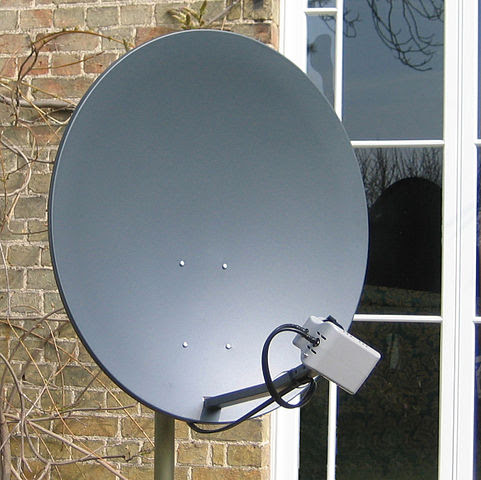
simple satellite dish antenna
If you're more motivated than I am to actually do something, here are some links that may interest you:

Some great projects using satellite TV dishes as antennas:
NRAO Information for Amateur Radio Astronomers

Jupiter and Other Simple Starter Projects:
Detect Radio Emissions from Jupiter
Small Amateur Radio Telescope

More projects from the U.K.:
UK Amateur Radio Astronomy

A book, with some thick crunchy bits, that I recall reading back when I was getting started:
Radio Astronomy for Amateurs

And more fun stuff:
Radio Astronomy Projects
Radiosky Radio Astronomy Projects

This year I'll probably be distracted by "chasing DX" in amateur radio. I got my license last year, and I've only recently made my first contacts on the "HF" bands (short wave radio, basically.) But I may see if I can tune in Jupiter along the way.
StumbleUpon

Friday, August 10, 2012

How Big is a Constellation

One of the most difficult things many people find in stargazing is learning the constellations. Most people can find Orion, and the "Big Dipper" here in the northern hemisphere, which pretty well passes for Ursa Major (the Big Bear.)

But others are more difficult.

Most constellations are not as well defined as the most popular ones. The three stars of Orion's belt are not only bright, but they're all about the same brightness. Which makes them easier to pick out. Then, finding the other bright stars of the body isn't that hard. Most folks don't bother picking out the stars of the head, shield, and so on.

The Big Dipper is an asterism (sort of a non-official constellation, the words asterism and constellation mean the same thing but they're used differently.) It is made up of seven stars of roughly equal brightness that stand out from the background of the sky around them.

But other constellations don't have nice patterns like this, with groups of stars of roughly equal brightness that are also brighter than other stars in the area, and with a nice fairly dark buffer space between them and the next constellation over.

Another thing that makes it hard to find constellations, even when you use a star chart, is having a sense of how large they appear in the sky.

Some are very large and spread out. Scorpius has a tail that stretches off across the sky. Ophiuschus, the Snake Handler, covers a large area next to Scorpius, along with the Snake he's holding. But the Fox and the Arrow are small.

Start With What You Know

Before wandering too far out into unfamiliar territory, it usually helps to start with the constellations you know. That way, you already have a sense of where something is in the sky, and a general idea of what its boundaries are. Knowing more there can help, too. If there is a constellation you already know, compare the version of it you recognise in the sky with the version of it on the star charts. Are there large parts of it you aren't counting in when you see it? Where does it begin and end?

Then, starting there, and considering the orientation (which changes over time), can you find some other constellation next to it from the chart?

If you've already taught yourself to find the legs of the Big Bear coming off the Big Dipper, and the nose of the bear, then you're prepared to find the Hunting Dogs, a pair of stars beneath the curve of the Big Bear's tail. It's not much of a constellation, just a pair of stars, visually, but it is another constellation.

Likewise, knowing both the Big Dipper and the Little Dipper, there's that line of stars running along between them. Those belong to Draco, the Dragon.

Further south, once you've found the limits of Orion's limbs, you can easily find the Rabbit beneath his feet. And the Big Dog to one side of him, with the bright Dog Star, Sirius, in it.

Pushing out your knowledge step-by-step in this way is a good way to learn constellations, because you can learn how to locate them again later, in a month or two, when the position of the constellations in the sky has changed.

Further Afield

There are a few constellations that look like what they're named for. Scorpius is one of them. The bright red star Antares makes it easy to pick out in a July/August sky, with the head and claws nearby in a nearly straight line of stars that, while not all that bright, are easy to associate with each other because they're about the same brightness.

From those, the Scorpion runs back through bright red-orange Antares then sweeps around in a long fish hook shape with a sort of barb on the end. (This constellation is Maui's Fish Hook to the Pacific Islanders.) A constellation that looks like its name, with a bright, distinctive star in it makes a good starting point when not working off a familiar constellation's side.

Then, once it is learned, other nearby constellations can be learned.

The Power of Asterisms

Just as the Big Dipper isn't an official constellation, but just a part of the Big Bear, there are other asterisms in the sky. Asterisms are more commonly named for what they look like than the traditional constellations. And many of them make up enough of the actual constellation they're part of that finding the asterism is about as good as saying you've found the constellation itself.

The Teapot is an asterism that occupies the main part of Sagittarius, the Archer. The Teapot shape is not hard to see once it "pops" for you. If you hold your hand out at arm's length but bend it so that it's at about a right angle to your arm, it will about cover the area of the Teapot. The Teapot lives behind the tail of the Scorpion.

It has a narrow right triangle as a spout, with the cloudiness of the Milky Way looking like steam coming from the spout. The body is a large trapezoid, which shares one side with the spout. On top (it's upside-down in the southern hemisphere) is a triangle of stars that's just a bit flat of an equilateral triangle which forms the lid of the Teapot. Finally, the handle is another trapezoid which is short and wide, with its bottom the side of the body that's opposite the spout.

If you're in mid-northern latitudes it will be in the south near the horizon during summer.

There are other asterisms like the Summer and Winter Triangles (the names are northern hemisphere centric) where each of the stars in the triangle is in a different constellation. By learning to find these, you get a foothold into three constellations apiece!

The Winter Triangle has a star in Orion, the other stars are in the Big Dog (Sirius, the brightest star) and the Little Dog (Procyon, the dimmest star in the Triangle.)

The Summer Triangle has a star in the Harp, the Swan, and the Eagle. Vega, in the Harp, is the brightest star. Deneb is a middling-bright star in the Swan, at the tail of the constellation (another constellation that has a resemblance to its name.) Altair is a bright yellow star in the Eagle. It forms one end of a pair of much smaller triangles that make up the wings of the Eagle.

Looking Gets You There

It's not easy to learn your way around, unless you have somebody who's patient, already knows their way around, and there's a green laser pointer for them to use. Even at that, once the sky moves over the course of a few weeks, you will need to get re-oriented. But once you take the time to learn on your own, or through a guide, you will be able to star expanding on what you know quickly.

Just as it's easier to find your way to more places around town, the more places you already know and can use as waypoints, you can find your way around more of the sky for each constellation you add to your personal list.

Pretty soon the individual ones you know that are away from each other start growing into ones you know that run into other groups of constellations you know. Then you're looking at the areas in the middle of the constellations you know and wondering what those stars are. Whole sections of the sky become familiar.

Learning the constellations is satisfying and enjoyable in and of itself. I still spend most of my time under the sky with no telescope or binoculars or other "distractions". But the side benefit is that once you do take out an instrument, you can now easily find many items to look at if you know at least a handful of the current constellations in the sky. Some of the best things to look at are placed in easy to aim at places in the constellations. Or, if you have a computerized telescope, you can more easily and more surely give it its guide stars to get its computer started off.
StumbleUpon

Wednesday, July 11, 2012

Hot Summer Solar Observation

Our community holds a celebration each year to one side or the other of the Fourth of July. We have a street fair, dachshund races, parade, and, usually, fireworks. Lots of locals like it because it lets them extend their Fourth of July celebration a bit and get in some extra fireworks each year.

Don Machholz organizes the local astronomers to take part in the street fair, where we take out our telescopes and show off the sky, as much as we are able, to the local community. We enjoy sharing our hobby, as well as letting them know about the other events we have going on.

Each year we have several solar telescopes out, as well as viewing planets in the daytime when the conditions are right.

Last year we weren't able to attend, but the year before that we were there, showing the sun and explaining to people that usually there are things to see there other than a featureless circle. But a featureless circle was about all we had to show. There was a bit of unimpressive detail through the H-alpha filters, but chances are most of the attendees that looked didn't get so far as noticing it.

This year was a great change for the better. There were sunspots, and prominences. Sunspots are nice since they show up in an ordinary telescope with a solar filter. We had a scope with a solar filter, plus a solar projection screen that both showed the sunspots very nicely. Viewers compared them to the islands of Hawaii.

Through the H-alpha filters there were a bunch of prominences around the edge of the Sun. Solar flares, if you will. They change with time, each lasting several hours or longer and changing their appearance over that time.

Why the Difference?

A normal solar filter shows all the different visible frequencies of light. All it does is cut the amount of light down to a level where it doesn't damage our eyes or the telescope. It's what we'd see if we could stand to look straight at the Sun and still make out any detail. Plus the telescope provides magnification that makes it look larger so that we can pick out small details more easily.

An H-alpha filter is a filter that only lets through one wavelength of light, the light emitted by one type of ionized hydrogen (that's where the "H" in H-alpha comes from, H is the symbol for hydrogen). This light is in the red wavelength for us, so the image becomes a "red and white" (as opposed to black and white) monochrome image.

This clears out other light frequencies that smear out or otherwise hide a lot of interesting detail on the Sun. In H-alpha light we can see the magnetic cells of the Sun. These cells are not like the cells in our bodies, the word cell originally meant "chamber" so it got used wherever early scientists saw things divided up into little "rooms" or "chambers".

It also allows us to see the energetic material being ejected, and pulled back into the Sun. Normally the other light hides these flares and loops and other prominences. But in H-alpha light, the other light is blocked out, allowing us to see these interesting solar features.

A Good Show, Again

So now we have a good show on the Sun again. This is likely to be the case for at least the next couple of years. Usually there are only one or two years out of each solar cycle (an 11 or 22 year period, depending on how you look at it) where the Sun isn't putting on a show. And the quiet period we're coming out of was far quieter and longer than any other I've ever experienced.

Which is nice. It's a lot easier to get people interested in what's going on "up there" when you've got something interesting to show them.
StumbleUpon

Wednesday, June 6, 2012

Transits of Venus

Hopefully you had the chance to see the transit of Venus yesterday (5th or 6th of June, depending on where you were). A transit, in astronomy, is when one body (usually a planet) passes between another body and the Sun. In this case, the planet Venus was directly between the Earth and the Sun. Another example might be when the planet Earth goes directly between Mars and the Sun. This would be a transit of Earth to the rovers on Mars.

Observing Venus

Image of Venus Transit of the Sun
Projected Image of Venus Transit from a Telescope run by George Robinson at the Auburn Dam Overlook in California.

Here on Earth we only have two planets to come between us and the Sun, Venus and Mercury. The Moon comes between us and the Sun, too, and those are solar eclipses, an even very similar to a transit (it wouldn't be totally inappropriate to call it a Lunar transit.)

Why is it Special?
You'd think this would happen all the time. After all, since Venus and Mercury are within the orbit of the Earth, and orbit the Sun in less time than we do, it seems like they'd always be crossing between us and the Sun. The thing is, those planets have orbits that aren't perfectly flat compared to ours. If their orbits were flat compared to the Earth's, then we would see them cross the face of the Sun every time they were at "inferior conjunction", that is, as close to us as they get in their orbit. ("Superior conjunction" is when they're on the far side of the Sun from us.)

But their orbits are tilted. That means that they need to be in a part of their orbit that is in line with our orbit at the same time that they are at inferior conjunction. With planet Mercury, this happens a bit more frequently than once every ten years or so. Since Mercury's orbital time is so much shorter than our own, there are many more opportunities for things to line up like this than with Venus.

Observing Mercury

With Venus, this sort of line-up only occurs a couple of times over the course of a bit over a century. For these last two occasions, those times were separated by eight years, leaving 105 years until the next line-up.

How It Looked
Yesterday was the first transit of Venus I've seen. I missed the last one because I wasn't in a position to travel at the time it occurred. I've seen transits of Mercury, so I thought I knew pretty well what to expect. I expected pretty much the same thing, with Venus a bit larger against the surface of the Sun.

In fact, it was a lot different. For one thing, Venus was a lot larger against the Sun than I expected. It was also a much crisper image, sharply defined at the edges, compared to Mercury. Mercury looked kind of fuzzy, like heat waves were around the edges. Venus was large enough that the edges didn't look this way.

We got to see it through several different telescopes, including two with H-alpha filters that let you see the prominences and solar flares on the Sun. One clever set-up from our friend Larry had a pair of binoculars rubber-banded to a piece of two by four lumber, with a cardboard sun screen, and the image from one of the two binocular lenses projected onto a paper plate at the other end of the two by four. The assembly was supported by the rungs of an overturned stool, which could be turned several ways to get different heights.
Simple Solar Observing Set Up, Viewing Venus transit.
Larry, the master of laid-back astronomy, brought this portable solar observatory along with his 8" Dobsonian telescope.

As much as I enjoyed looking at various magnified images, I was most impressed by looking at the Sun directly through a pair of solar filter glasses. The circle of Venus was easy to pick out (Mercury isn't), and it looked a bit eerie just hanging there in the sky in front of the Sun.

It will be a long time until we can see another transit of Venus on Earth (105 years), but there will be a transit of Mercury in 2016, and spaceflight offers more opportunities for viewing transits off of Earth. Hopefully by the time of the next Venus transit, viewing transits of the planets won't be limited to the Earth and low Earth orbit.

A good article on why transits happen as infrequently as they do is at Sky and Telescope.
StumbleUpon

Saturday, April 14, 2012

Stargazing: Looking to See

Whether you're using your eyes or a telescope or binoculars, it takes time to see everything you can see.

To see the most, pick details out of faint contrast, or simply enjoy the view takes enough time to relax a bit and soak it in.

That means you have to be able to spend some time doing it. Which is not possible if you're uncomfortable, you or any instruments aren't stable, and if you just don't take the time.

There'll be more to see, and enjoy, in the sky if you give yourself the things you need. Time, comfortable clothing, a good, safe place to observe, well-chosen instruments with the right accessories for basic use, a place to stand, darkness.

It sounds obvious, but I know I've talked myself out of one or more of these at various occasions. I doubt I'm alone.

Dark skies and good seeing.
StumbleUpon

Tuesday, March 6, 2012

Seeing Mars in 2012

We're near our opposition with Mars as I write this (March 2012), an event that comes every 26 month, approximately. This year, we're going to have a Mars in our sky at night for many months:

  • March: up all night. Size: 13 to 14 arc seconds. Brightness: magnitude -1.0!

  • April: up till about 3:30am. Size: 10 to 13 arc seconds. Brightness: magnitude -0.35!

  • May: up till about 2am. Size: about 9 arc seconds. Brightness: magnitude 0.26.

  • June: up till about midnight. Size: about 7 arc seconds. Brightness: magnitude 0.7.

  • July: up till about 11pm. Size: about 6 arc seconds. Brightness: magnitude 1.


As you can see, Mars will be bright and fairly good sized for much of the year. However, in July Mars will be less than half the size it is in March. That means it will take over twice the magnification to get a comparable level of detail. But it will be dimmer, too. So the closer to the opposition you view, the better view you'll get. The fact is, magnification will not make up for the smaller size of Mars.

But Mars will still be putting on a good show, even this summer when it will be nice and warm out at night.

Mars
StumbleUpon

Tuesday, January 24, 2012

Observing Mars

Mars is getting close to its "opposition". That's the best time to observe Mars, generally (depending on conditions otherwise.) That's because that's when Mars is closest to Earth, and it is its brightest.

Image by amateur astronomer Arnomane of Wikimedia
Image by Arnomane

That also means that Mars is at its largest, as viewed from Earth. Oppositions occur roughly once every two years. This time, Mars will be about 13.9 arcseconds across, at a distance about 1.66 times the distance to the Sun. For comparison, the Moon is about half a degree across, or just about 30 arcminutes. Each arc minute is sixty arc seconds. That means that the Moon is about 1800 arcseconds across.

The Moon is large enough to see a fair amount of detail by eye. But to our eyes, Mars appears only as a bright dot, even at its largest. The minimum angular resolution of the human eye is about 1 arc minute, or 60 arc seconds. Mars would have to be over four times larger for us to see it as anything other than a dot by eye. It certainly never gets as large as the Moon! This is known as the Mars Hoax, an internet hoax that's been going around, and around, and around on the internet for about nine years now. It just can't look that big!

Make It Bigger

Since we can't see a lot of detail by eye, we use magnification to see the detail of Mars's surface. At the low magnifications of ordinary binoculars (7x to 20x), Mars shows as a small disk, but little or no detail is visible. A stable mount and higher levels of magnification are needed, which means that a telescope is the best instrument for observing Mars.

Mars will begin to show details at about 35-50 powers of magnification. This is low magnification for your telescope. At this level large things like the polar ice caps and Syrtis Major (pronounced like "Sir Tiss Major"), a large dark area on Mar's surface, become visible. To see more details requires increased magnification.

How much magnification you can use will depend on the observing conditions, the quality of your scope's mount and tracking, and your experience in astronomical observation. Mars is a good object to learn with. It's bright, it has both strong and subtle details. If you want to get good at using higher powers (over about 150-200x) on your telescope, this is a great opportunity.

For myself, I do my detailed observation at about 350-400x. At this level I find I can get the most detail with my 8" Newtonian telescope without it being a strain to track Mars with my scope, or having to break off my observation too often. Larger telescopes, and very well made refractors with good mounts will be able to use higher powers, but for most observers with little high power experience, anything over about 200x will be challenging.

Now in Living Color!

To tease out the finest details of Mars, it can be very beneficial to use colored filters. I have two sets of colored filters that I use for general observation. Dim objects don't work well with filters because the filter cuts off too much light to leave a bright enough image to see. Fortunately, Mars is quite bright.

I observe Mars with all the different colors of filter, but I find the red and yellow color filters to bring out the most unique detail. A blue filter is often worth observing with, it brings out polar caps and clouds on Mars. Yellow and orange filters bring out details, usually better than a red filter.

There are no hard and fast rules I've found in my own observation of Mars with colored filters. Different viewing conditions and different seasons on Mars each have an effect on what will be seen. So I usually cycle through all of them in an evening, then go back to those that brought out the most unique detail.

Take a Picture, It'll Last Longer

To really teach yourself to see detail, try doing sketches of Mars at the eyepiece. I draw several circles on a sheet of paper ahead of time for the outline of the planet (or just print out a sheet with circles about 2" in diameter on it), then sketch in basic light and dark areas with a normal pencil.

I then take notes of the time, date, magnification, and any filters that I am using. I make sketches with each of the different filters that I find work well on Mars during that observing session.

When I'm observing without a filter, I make notes on the colors of the details and try to fix them in my mind. Later, when I'm inside with light, I color in areas of my sketch with colored pencils to try to capture the colors, or color differences, that I saw on Mars.

Drawing Mars really helps you to learn to see the details on Mars. It also gives you a personal record of what you saw. You can go to the internet with the time that you saw Mars, or to your favorite astronomy program, and look up Mars's orientation at the time you drew it. Compare what you find with what you drew. It will never look the same, but you can see a match between different parts of your drawing and the image of Mars as it was when you drew it. Going back later, you may see other details that you didn't capture in your drawing.

At which point it's time to start another drawing. :)
StumbleUpon

Saturday, January 14, 2012

Cold Weather Astronomy: Be Prepared!

In my prior article I discussed ways of staying warm and safe while observing in the cold by controlling your location and taking advantage of what's nearby. In this article I'll discuss personal preparation and protection from the cold.

Fashion Sense and Sensibility

Obviously clothing is an important part of staying warm when out stargazing in winter. Having the right clothes for the conditions is critical. When it's really cold, it's not something you can fake easily with substitutions. Proper winter wear that protects both your core temperature and your extremities is critical.

Humidity Good and Bad

Even though the humidity high in the sky is very low, thanks to the cold conditions, the humidity levels at ground level can be quite different. If it's at all damp where you are, this can make it feel far colder than the temperature would suggest. Also, as the evening cools this dampness can condense on you and freeze as well. So any clothing used must protect against moisture.

While humidity outside your clothes can be a problem, inside your clothing it's part of keeping yourself warm. Clothing that helps trap your body's moisture to some degree helps keep you warm. The colder it is, the more your clothing should confine the moisture.

The Layered Look

Layers of clothing are important, both to provide redundant levels of protection from the cold and to serve different purposes. Clothing worn near the skin should be porous and absorbent to keep moisture from collecting on the skin, which can chill. It also allows the warm air trapped within your outer clothing to circulate some to better distribute your body's heat.

The next layer out should be chosen for warmth, and should also breath some. Wools and acrylics are good choices, as they will keep you warm no matter what the level of moisture.

The outer layer should prevent wind from getting in and your body's heat and moisture from getting out.

Easily Freezable Bits
Hands, feet, ears, and other outer parts of your body deserve special attention. They freeze easily, and are easier to forget when a particularly nice bit of galactic detail swims into view.

Heated socks and gloves are available, and heated hats. Some use batteries and heating elements, others use chemical packs to generate warmth. In my case I've found aluminized clothing to work just as well. I have aluminized socks and glove liners that I wear in cold weather. They work so well they literally feel as if they are electrically heated.

For example, I usually wear the following on my feet:
  • Inner cotton socks

  • Acrylic knee-high socks

  • Aluminized socks

  • Outer wool or thick cotton socks


I have a loose pair of older leather boots that I wear in winter to accommodate these layers of socks.

On my head I wear a balaclava under a heavy winter hat.

On my hands I wear a pair of cotton-lined aluminized gloves, with a pair of leather "police inspection" gloves outside of them. These aren't quite enough to protect my hands on the coldest nights, but I use these because it still leaves me enough dexterity to handle eyepieces and focusers. I put my hands inside heavy pockets when I'm not actually handling things, or use an outer pair of heavy mittens if I'm not going to use the pockets or if the pockets just don't stay warm enough.

Internal Preparation

Before going out into the cold, it's important to be well fed. Don't go out hungry, it leaves your body with insufficient reserves to keep you warm, and keep you alert enough to notice if you're getting too cold to be safe.

I usually plan a warm meal with a warm drink before going out. I also keep something warm to drink, and a high calorie snack available for observing breaks. If at all possible, these breaks should be taken in a warm place.

Breaks and Self-Inspections
Plan to have breaks in your observing sessions. They should be long enough to let you warm up completely. You need to be able to tell if parts of you are getting too cold, or if you're having trouble making decisions clearly. I do a bit of observation logging during my warm-up sessions to give me something to do while warming.

When outside, and when inside, perform a self-inspection to see if any part of yourself is getting cold and numb. Frostbite is not a necessary part of astronomy. Check your fingers and toes for flexibility and feeling. Check your ears, nose, chin, scalp, elbows and knees. Poke your calves and forearms while you're at it. Blink your eyes and make sure any cloudiness blinks away. Touch any exposed skin to make sure it's still there.

Two Ways to Err
It's possible to make mistakes in either of two ways: being too gung-ho and ending up regretting an observing session that goes too long or that you get too cold. It's also possible to miss out on some of the best observing time of the year by being too timid and hiding from the cold when the proper location and dress would be all it takes to have an enjoyable time under the sky.

Don't miss out on winter observing, and don't over-do it, either!

Plus, if you have any personal tips or tricks you use, please share them in the comments.
StumbleUpon

Saturday, January 7, 2012

Keeping Warm When Observing in Winter

Winter skies can be some of the best of the year. But it's hard to enjoy them if you're not safe and comfortable while observing. Cold air may being doing something wonderful for the skies above, but there are lowly land-level things to take into consideration.

Losing Sky to Gain Warmth
Where you observe can have a lot of effect on the conditions. Open areas far from buildings and trees are the best for views of the sky, but they are usually the coldest as well. Ground level temperatures at night are strongly affected by radiation of heat from the ground. When the area has a clear view of the sky, it radiates its daytime heat more readily into the sky, cooling more and faster than if it has partial cover.

If it's just plain too cold to enjoy the sky from a completely open area, observing the sky from one or more sites that have some partial cover can save the evening. It can be several degrees warmer in a location that has partial tree cover. Buildings keep the areas immediately next to them warmer as well. If you are viewing in a direction away from the building, any air currents caused by heat coming off the top if the building can be avoided.

By choosing partially covered locations well, you can move from place to place and be able to observe all or most of the sky without being quite so cold.


Cover the Cold Ground
Observing atop a non-porous ground cover helps significantly as well. A tarp or sheet of painter's plastic makes a good ground cover. Something else thrown on top of the ground cover will help keep the site even warmer. An old blanket, chunk of carpet, or some other form of insulating material on top of a ground cover will help make the observing site far more comfortable.

Wind
If there is any wind, some form of wind block will obviously be helpful to staying warmer. For foliage and sizable structures, you'll usually get the best protection on the downwind side of it. For smaller or erected wind breaks, the best protection may be on the downwind side but in many cases will be on the upwind side. In these instances a dead zone forms in the upwind area, whereas the downwind side may actually be colder due to air flow caused by the low pressure area formed on the downwind side. Be prepared to try both. This can also occur with some building layouts, but is more common with small wind screens, fences, and the like.

Slippery Slopes
Sloping ground can also be colder than flat areas. Convection along the sloping surface can make for a drifting draft that chills astronomers. At my prior home we lived on a slope just beneath a ridge line. Our weather was far colder than many other places at our elevation. We would have snow at times when the properties around us were clear. Our location gave us a great view of the sky, but it was colder.

In one corner of our property there was a dell with less of a view of the sky, but warmer air tended to pool there for some reason (I'd have expected it to be colder.) But I noticed that snow appeared there later than anywhere else nearby. Once snow got in there it stayed later than anywhere around because it received little sunlight. But at night, it was one of the warmest places to be, thanks to low airflow, partial tree cover, and a thick bed of leaves on the ground.

It's also important to be in a safe place to stand and move around a bit in the dark. Our present property has a steep section above a cut. It happens to give the best views to the north and east, but most of it isn't safe to traverse at night without light and extreme care. For this reason, I avoid it. Falls and injuries are a bad way to end an observing session. And it doesn't get you any warmer.

Warm Up Shack
Having a nearby location where you can take breaks from observing and warm up is a good idea. My number one observing location is at home, but I also travel to nearby locations that give a better view than my home. At the very least, I have my car as a place to go for breaks. I keep both a wool blanket or sleeping bag and a space blanket on hand. I run the engine for the heater while inside, and put a piece of cardboard on the dash to block the lights to preserve my night vision.

I keep some high calorie snacks in there, and a thermos of something warm to drink when I've though ahead that far (boy, I regret it when I don't!)

A car isn't the best warm-up shack, and a club site or other prepared observing location can have a dark warm-up room that allows you to duck in for a while to warm up, count your appendages, and generally decide whether to continue your time under the sky in warmth and comfort without having to wait half an hour for your night vision to fully return just because you wanted to get in out of the cold for a bit.

At home, I work with my family to choose a door I can go in and out of to a darkened area. That makes it easier for me to come in every so often without having my night vision ruined every time I do. Usually I keep my log and a red LED light there, I'll update my log while I'm warming up and possibly think of some more things I can look at if I go back out.

Having something to do when I first come in makes it easier for me to wait the time it takes to get warm enough to make a reasonable decision about whether I should go back out, and to keep me from rushing back out before I'm really completely warmed up. Not being able to feel your feet isn't a good sign, but it's one I've missed at times when I didn't make sure I got warmed up properly before going back out (fortunately the warming was enough that I did get sharp pains about ten minutes after going back out, rather than just numbness. That hint I did catch!)

Prepare Yourself

In the next article I'll discuss what you can do in the way of clothing and self-preparation to make winter observing more enjoyable.
StumbleUpon

Sunday, January 1, 2012

Winter Observing

This time of year is winter for us in the northern hemisphere. It's one of my favorite times for observing. Both with telescopes and with my eyes or binoculars. Even if it's nothing more than lingering in the driveway to enjoy the sky for a few minutes after a drive home, the clarity of the sky makes the stars stand out with the best contrast of any time of the year.

Winter brings cold, but on clear nights that cold makes the sky especially clear. The upper level cold freezes out moisture in the air. It's a perfect time of year for looking at faint fuzzies. If you have a smaller instrument, this is a great time to see things that are fainter than you can normally expect to find when the humidity is higher.

I have started many of my personal observing programs during this time of year, including seeing how many galaxies I could see with 7x35 binoculars, learning my way around the deep sky north of 70 degrees with a 75mm reflector, and seeing how close of doubles I could pick out by eye. The sharp appearance of the sky makes winter the perfect time to start new observing objectives.

With larger instruments, this is still a good time to view objects that are challenging, or to see more detail in familiar objects, like picking out more detail in galaxies.

Whether you're using your eyes or a light bucket, now is the perfect time to get out and enjoy sharp, high contrast skies. While the clouds are away, let the cold air freeze out the atmospheric humidity so that you can get the best views.

Stay warm with layered clothing, good socks, and good gloves.
StumbleUpon

Friday, November 11, 2011

Observing the Earth

One of the easiest planets to observe is our own, the Earth.

It is possible to view the Earth as an "astronomical object", in a way, even though you're standing on it. One way is to view your local daily cycle of night and day as it appears on other planets and the Moon--becoming aware of the terminator as it passes by twice each day.

Another is to enjoy the events of the Earth's own sky. Clouds, colors of sunlight, meteors, and auroras are all Earth phenomena that we can enjoy as astronomers. The play of light on clouds, especially at sunset and sunrise, is not only beautiful but can tell us what the sky is going to be like in the next several hours.

Meteors can be seen on most any clear night, preferably with little moonlight. The best scientific instrument for watching meteors is a reclining lawn chair, such as a chaise lounge. Meteor showers occur regularly, but even when there are none there are a fair few meteors, and I've spent nights under the sky where I was sure there must be a shower, there were so many meteors, when there was none.

Auroras are rare at my latitude, but that makes them an even more special phenomenon. Whether I go to where they are, or whether the Sun's activity brings them to me. They're amazing and magical.

Even when I can't see the universe beyond our own atmosphere, there are clouds and often lightning to see. No night need be a "wasted" night. And if you really must observe the universe, consider making a simple radio telescope!
StumbleUpon

Sunday, October 30, 2011

The Phases of Venus

Venus is the second planet from the Sun, and makes for a satisfying viewing target. Though it is covered with clouds at all times, it is not devoid of detail.

The planet Venus shows phases, like the Moon. In fact, the most common comment I hear when showing Venus through my telescope is "It looks like the Moon!"

During the daytime, it can be seen as a ghostly moon-like object. It takes great care to keep the telescope from viewing the Sun. If this can be managed, Venus shows up well during the day. The trick is to position the telescope away from the Sun, on the same side of the Sun as Venus, by using the shadows on the telescope without looking through the scope (and probably covering the end of the scope to keep the sunlight out!) Then, once you're sure there's no Sun in the scope, look through and sweep away from the Sun. Practice sweeping in the correct direction before your eyeball is at the scope.

At night, you don't have to worry about this. If anything, you may find Venus is a bit too bright. A color filter or neutral density filter can help cut the light down a bit to make it more comfortable to view. Careful and patient use of a variable polarity filter can reveal murky details in the clouds of Venus.

Venus shows a full set of phases, from new and thin crescent phases to a Full Venus.

It can be a lot of fun to watch Venus from week to week as its phases change. It goes much more slowly than the Moon, overall, but there are some phases that seem to shoot past, and others (like full) that seem to last forever.

Ordinary binoculars won't show the phases clearly, but when Venus is away from "full" it'll sure look like something's wrong. Crescent phases can take on all sorts of interesting shapes in binoculars, sometimes looking like a line, other times looking just mis-shapen.

For the early Greeks, Venus has two names depending on whether it was a morning star or an evening star. As a morning star it was Phosporus, it was called Hesperus as an evening star. In the sixth century B.C. Pythagoras recognized it as a single object, which was named Aphrodite and later given the Roman name Venus as the goddess analogous to Aphrodite.
StumbleUpon

Sunday, October 23, 2011

Viewing Planet Mercury

Planet Mercury is the closest planet to the Sun. Its orbit around the Sun is entirely within the orbit of the Earth. This means that from our point of view, Mercury always appears in the sky near the Sun. Sometimes it is seen setting in the evening shortly after the Sun sets, other times it is seen in the morning just before the Sun rises. At other times it is invisible, lost in the Sun's glare.

The early Greeks had two names for Mercury, depending on whether it was seen as a morning star or an evening star. As a morning star it was Apollo, as an evening star it was Hermes. It was later recognized to be a single object, and the name Hermes, the messenger of the gods, was the precursor to the Roman name Mercury that we use today.

Mercury can be seen by eye as a medium-bright red-orange star near the Sun. Binoculars will show that it's not a star, but a very small disk-like shape that looks un-star-like. It looks much the same in a telescope, though under good conditions it will show a "phase" like one of the Moon's phases, most commonly a crescent, since it is usually seen when well away from the Sun. It doesn't show any detail in telescopes, it just appears as a small reddish-orange shape, its shade of color varies some because of Earth's atmosphere.

At times it moves very quickly across the sky. Its position relative to the Sun, and to the stars in the sky, can be seen to change rapidly from day to day. It makes an interesting project to keep track of Mercury's position in the sky on a star chart over the course of a month or two.
StumbleUpon

Friday, August 5, 2011

Learning the Constellations

Learning your way around the sky at night is a matter of learning to see some of the patterns in the stars so that you can pick out particular stars, and have an idea of where other stars are with respect to them. It's a piecemeal process that takes a bit of time, but is very rewarding.

One Step At a Time

Don't expect to learn a lot of constellations all at once, or, if you do, don't expect it all to stick. Part of the challenge is that the constellations change their place in the sky all the time, and that the ones that are visible will vary by the season.

Because of this, if you learn some constellations tonight, then come back out under the sky in a few weeks, the constellations will have moved. As the Earth goes around the Sun in its orbit, the constellations up at a particular time of night will change a bit and those that stay up will appear to have moved in the sky. They will also change their orientation, so the stars that were on the bottom are now on the side.

Don't be discouraged. Learn the stars by relative positions. Turn yourself and your body around to see the patterns you've memorized. Where possible, get out often to see them before they've changed beyond recognition.

Season's Greetings
Since different stars are up in the early evening at different times of the year, it's also useful to divide the constellations you know by the season you see them. For myself, The Archer, The Scorpion, The Snake-Handler, and The Virgin are summer constellations. Orion, the Big Dog, Small Dog, and Gemini are winter constellations. Perseus the Hero, Andromeda, and Pegasus are spring constellations.

When I see one of these, I think of the others and locate them in the sky by the one I see first. In fact, these constellations are not just visible in the season I think of them belonging to, but that's when I learned them, and that's when I know I can see them on a clear night with a good view of the sky around me. It breaks up the job of learning what's where.

High and Low
It's often easiest to locate new constellations when they are either near the horizon in some direction, or at the highest point in the sky. The ones that are in-between often seem to be harder to get a handle on, unless they have some special feature that makes them easier to see as a constellation, like the Big Bear's seven stars of the Big Dipper that are all about the same brightness in the same part of the sky.

With a star chart for the time of year you're out, and the time of night, you can see what should be near the horizon in any given direction as well as what should be directly overhead. Pick out particularly bright stars on the chart to use as guides. Then find other bright stars on the chart, and locate them with respect to the first one you found. Then look at the less bright stars, and get them placed with the constellation they belong to. After a while, you should be able to see the "picture" of the constellation in the sky.
StumbleUpon

Tuesday, July 12, 2011

Wine Tasting Under the Stars

If you haven't had a chance to enjoy a star party, either as an astronomer or an attendee, I highly recommend going to one. Chances are there are astronomers in your area who hold regular star parties. In my fairly remote area, there are at least three groups running star parties on a regular basis.


One of the star parties I helped organize this year was at a local vineyard. They combined our star party with a wine-tasting and music event at their site. We did this star party at David Girard Vineyards, in Coloma, California.

We had six different telescopes out at this event (the sixth arrived after these pictures were taken.) Attendees got to see a wide variety of astronomical objects through the scopes while enjoying wines, cheeses, and so on. It was a very nice event for everyone.


Attendees got to see the heavens not only through the astronomer's telescopes, but with their eyes alone on green-laser guided tours of the constellations. Green laser pointers are used because the beam itself is visible at night, so it can be used to point things out under the real sky just as effectively as a planetarium lecturer can point things out in their dome.

The astronomers who chose to partake of the wines got to enjoy those while showing the skies, and we all enjoy sharing our hobby and knowledge with an appreciative audience. When I spoke to the other astronomers afterward (there's usually little chance for us to talk among ourselves while during the event itself), we all felt like the time had gone by amazingly quickly. This is a good sign that everything was going well, and that we all had lots of interested attendees to show the sights in the skies.

For at least one of our astronomers, this was their first time showing the sky to the public. It's a great experience, no matter what your skill level is in astronomy. There are always a few basic, easy to find objects you can show off at a star party. So long as you're familiar with your equipment and it's in good enough shape that you don't have to fiddle with it constantly, you're ready to do star parties.


I've been sharing the skies myself for over 40 years now. It started without any doing on my part. I got my first telescope when I was very young. I'd set it up on our front lawn to look at the Moon and stars while I was learning my way around the sky and my new telescope. This was during the heat of the space race, in the 1960s. People driving by on the street would see me with the telescope, stop their cars, and come have me show them things through my telescope.

For many people it was the first time they'd actually seen craters on the Moon with their own eyes. Even objects as simple as bright stars would interest them, even if I didn't know the name or constellation yet.

Their questions got me to learn more about what I was looking at. They'd ask me where the Surveyors and Rangers were on the Moon (Apollo hadn't landed yet.) That made me learn my way around the Moon with a map from National Geographic magazine that showed the locations of the probes, as well as the selected Apollo landing sites. I memorized them and that allowed me to answer the questions about the Moon. Similarly, I learned the names and constellations of the brightest stars, which was much harder since I really didn't know my way around the sky, yet.


The breakthrough came when I learned from a copy of Sky and Telescope in the library that the correct way to use a star chart is to hold it over your head. Just as you hold a map of the ground down low, and align it with the Earth, you hold a sky map over your head, and align it with the sky by putting it's north to your north.

If you are an amateur astronomer, find or organize a local star party. You'll find it improves your appreciation of your hobby in too many ways to list. If you're just interested in astronomy, find one to attend and enjoy. It's like having not just one telescope of your own but a whole bunch of self-pointing, self-maintaining telescopes to enjoy the heavens through.
StumbleUpon

Tuesday, June 14, 2011

Double Stars

About half of all the stars in our galaxy are part of a multiple star system. Either a binary star, triple star, or a larger group of stars. The stars are bound to each other by their mutual gravity so that they orbit each other. This puts them close enough to each other that we see them together in the sky.

In some cases the stars are of different types or sizes, so they make a striking pair when you look at them through telescope or binoculars. With half the stars in our galaxy being in multi-star systems, these pairs can be found all over the sky. I've found that the colors in stars are different through different sized scopes, certain colors are more intense with different diameters of scope. So it's interesting to look at the same pair of stars through different scopes on the same night to see how they look through each.

Albireo

Visually, Albireo is the star at the head of Cygnus the Swan. It's easy to see most of the year in northern latitudes. Through binoculars or telescopes the colors of the stars make for a striking contrast. One star appears as blue or white, depending on the night and your instrument. The other ranges from a deep amber or orange to a fair yellow. Whenever we're at a star party, if my wife hears that Albireo is in somebody's scope, she rushes over for a look at this celestial gem.

Albireo, a beautiful double star. Image by Hewholooks.
Albireo, image by Hewholooks


Use low magnification (<100x) on Albireo if you're using a telescope. You might want to take a second look at a medium level of magnification (about 100x) to see if there's a color change at this level.

Cor Caroli

Cor Caroli, "Charles' Heart", is what folks usually expect to see when you say "double star". The stars are of very different brightness, and it takes just a bit of effort to see the dimmer star in the glow of the brighter star. Low magnification will reveal the dimmer star, I usually show this star at 40x. Medium levels of magnification will make it easier to pick out the companion, but will tend to make the difference in brightness not as strong.

Cor Caroli, in Canes Venatici.
Cor Caroli


Visually, Cor Caroli is the brightest star in Canes Venatici, under the curve of the Big Dipper's handle. It's visible year-round in northern latitudes.

Algeiba

Algieba, or Gamma Leonis, is another pair with fine color. It's part of the backwards question-mark that forms the head and chest of Leo the Lion. It's the lower star in the back of the curl of the question mark.

Algieba, in Leo, a beautifully multi-colored double star.
Algieba, image by Roberto Mura


Binoculars will reveal the double, but I prefer to view it at low powers in a telescope.

Omega Scorpii

This is another blue-yellow pair in Scorpius, just a bit toward the head of the Scorpion from the northern claw. It's visible from both northern and southern hemispheres.

Omega 1 and Omega 2 Scorpii.
Omega 1 and Omega 2 Scorpii, image by Roberto Mura


This pair is widely separated, almost as much as the width of the Moon. View at low magnifications, or with binoculars. The entire area of sky around them is magnificent through binoculars.
StumbleUpon