Showing posts with label telescope guide. Show all posts

Friday, November 8, 2013

Eight Great Telescopes That Aren't Hubble

The Hubble Space Telescope has successfully become the most famous telescope in the world. It has maintained this popularity through many years of operation, repeated news events surrounding the telescope, and promotion through sharing its imagery with the public through various venues on the internet. It's so well known that any time an average member of the public sees a detailed astrophoto they're more likely than not to ask if it's a Hubble image.

But Hubble isn't the only great telescope out there. In fact, while it is still a very valuable instrument contributing much to current science, its capabilities have in many ways been eclipsed by other instruments. After all, the Hubble was conceived and designed when an Apple II computer, running at 1MHz with an 8 bit processor and about 128KB of RAM was a serious work computer. So, while we recognize and accept the greatness of Hubble, let's have a look at some other telescopes that have been eclipsed by its popularity.

The Chandra X-Ray Observatory

Chandra X Ray Observatory Satellite
The Chandra X-Ray Observatory was one of Hubble's sister scopes in NASA's Great Observatories program. While Hubble was designed to cover the visual and near-infrared part of the electromagnetic spectrum, Chandra covers X-Rays. One of the great advantages of Hubble was that it was outside the atmosphere, eliminating the effects of the air on its images. In Chandra's case, getting outside the atmosphere is critical, x-rays don't penetrate our atmosphere to any degree. A ground-based x-ray telescope would be blind.

Despite coming from the same overall program as Hubble, the Chandra has gotten far less notoriety. Its images are no less beautiful, and are arguably more scientifically valuable since much of what Hubble does could be reproduced with other instruments. The same can't be said of Chandra.

The Spitzer Space Telescope

Spitzer against an infrared sky in space
Spitzer was also part of the Great Observatories program. It is the full-featured infrared complement to Hubble. Infrared is another part of the electromagnetic spectrum that is interfered with by the atmosphere far more than visual light. High altitude observatories can get above enough of the atmosphere to do IR observation from the ground, but getting into space is far better.

Infrared observations are especially important compared to visual light because IR wavelengths penetrate gas and dust better than visual wavelengths. On top of that, the effects of red-shift--light being shifted to lower frequencies by the expansion of the universe--means that to observe the visual light emissions of far away objects in space we need to look for infrared light here. It's been red-shifted out of the visual light spectrum entirely. Observations of the early universe rely on IR telescopes. This is why the new large space telescope, the Keck, often hailed as "Hubble's replacement", is being designed to work in IR wavelengths.

Aside from its scientific value, Spitzer also produces images of great beauty and wonder. Like Chandra, it has lived in Hubble's shadow for over ten years now.

The Great Observatories were originally rounded out by the Compton Gamma Ray Observatory. Its stabilization systems broke down after years of operation, and it was brought back down into the atmosphere for destructive re-entry. The remaining Great Observatories are still working today to produce valuable new science.

Fermi Gamma Ray Telescope

Fermi satellite image, a box with wings.
Fermi is the successor and advancement over the Compton Gamma Ray Telescope. Like the Compton, it is an orbital telescope. It observes the highest energies of radiation in the electromagnetic spectrum. It's been in operation for over five years as of the time I write this, and is extending its mission time in space. We hear about Hubble all the time, but this telescope has been working away in space, revolutionizing science for five years. Have you heard of it? (If you read a lot of astronomy magazines and journals like I do, you almost certainly have--if you get information from less specialized sources, you've could easily have missed it or forgotten about it even if you saw a short segment on it somewhere.)

Fermi was originally called GLAST after its main instrument, the Gamma ray Large Area Space Telescope. Once again, this telescope is designed to see things that Hubble can't see. Rather than looking as small, specific parts of the sky it scans the entire sky every three hours. It is used to image particles that are travelling just under the speed of light, the most energetic particles in the universe. This allows us to study physics in ways that we can't reproduce in laboratories on Earth. You think the Large Hadron Collider is powerful? The physics powerhouses that Fermi studies make LHC look like a pop-gun!

Large Binocular Telescope

large binocular telescope with doors open, showing dual telescopes inside.
Before Hubble, the Palomar Hale Telescope got all the press. It was the "200 inch telescope", the biggest in the world for a long time. Even after the Bolshoi Telescope was built, many Americans (at least) still thought Palomar was the largest. (Though the Bolshoi has always had problems that kept it from having the best performance. However, it is still used and is being upgraded again.

Today, the relatively unknown Large Binocular Telescope sports a pair of mirrors, each 331 inches in diameter! That means each mirror has over 2.7 times the light collecting area of Palomar's Hale telescope. Together, it's about five and a half times the light collecting area. But, as they say in the commercials, that's not all.

The Large Binocular Telescope uses adaptive optics (AO). This is a means of flexing the optical surfaces of the telescope to get the best possible image. The adaptation happens in real time, allowing the telescope to eliminate much of the problems from observing from the ground, rather than in space. In essence, if we'd had working adaptive optics back when Hubble was being designed, we would have already had ground-based telescopes that can see as well or better than Hubble! If we'd gone ahead with launching a telescope into space (still a good idea), then we would have had to build a telescope even more amazing than Hubble to justify the extra cost and effort (Hubble cost as much or more than a huge ground-based observatory project.)

But, reality is that we pulled together all the parts to build adaptive optics into ground based observatories after the commitment had already been made to Hubble. So now we have many ground based observatories that can out-perform Hubble, the Large Binocular Telescope among them.

The South African Large Telescope

SALT Observatory in daytime
The South African Large Telescope is the largest telescope in the southern hemisphere. Now, space telescopes like Hubble, Fermi, Spitzer, and Chandra don't care about hemispheres, but here on Earth you can only see so much of the sky from any place on Earth. It has roughly four times the light collecting area of Palomar's 200 inch (5.1m) Hale telescope. Its main mirror is a segmented mirror. Whereas the LBT has two mirrors that work side by side as two optical trains, the SALT telescope has 91 individual mirrors that all work together to form one big mirror, creating a single image. The mirrors are all made to work together through careful alignment using laser calibration. Also, rather than tracking the sky like other telescopes, the telescope stays fixed in place, while the instruments attached to the telescope track to capture the light from the object being observed.

The Magellan Telescopes

The Magellan Telescope buildings at night, lit by ambient light
Image by Krzysztof Ulaczyk
The Magellan Telescopes are a pair of telescopes that each use a single 6.5 meter mirror. They can work together, like the telescopes in the LBT, or they can work independently. Their large reflecting surfaces are made up of a single mirror, rather than a lot of smaller mirrors put together to act as a single mirror, like SALT. The mirrors are not a single large thick slab, like the Palomar Hale Telescope, however. They have hollows inside, they've got a honeycomb-like structure inside that supports the reflecting surface without being solid. Each mirror has well over 1.5 times the light collecting area of the Hale telescope, and, like the LBT, they are equipped with adaptive optics to clean up the image.

The Keck Observatory

The twin Keck Telescope Domes
Hubble's launch ended up being delayed, then, once it was launched, it had optical defects that budget cuts had eliminated the tests to catch (the back-up mirror, which still sits here on the ground, was perfect, so it's not like it would have cost a lot to solve the problem if it had been caught.) This meant a further delay while corrective instruments were designed and a half-billion dollar Space Shuttle mission to perform repairs was mounted. During that time, work on ground-based observatories did not stop.

The Keck Observatory was the great project that brought together so many of the advancements from the time between the start of work on Hubble and Hubble reaching its scientific potential. It used segmented mirrors to produce a collecting area far greater than the Palomar and Bolshoi telescopes. It added adaptive optics, as well as a second advancement to the optical train, active optics.

Active optics are similar to adaptive optics, in that they make adjustment to the optics of the telescope in real time to make a better image. Active optics, however, primarily correct environmental problems from being on the ground, rather than correcting problems with the image caused by the atmosphere (which is the purpose of adaptive optics.) Active optics correct for the pull of gravity on the mirrors changing as the telescope moves to follow objects across the sky. It corrects for changes in temperature, mechanical stresses on the mirrors, and so on.

Active optics keeps the mirrors within the telescope's main reflector as perfect a reflector for the telescope as possible. Then adaptive optics kick in later to clean up the effects of the atmosphere. The result is that the Keck can produce more detailed images than Hubble.

On top of that, Kick added a second telescope that can combine with the first to work like one really huge telescope. This not only increases the light collecting area, but the apparent aperture size of the telescope. That allows for resolution of finer detail (whereas increased collecting area allows the detection of fainter objects.)

Gran Telescopo Canarias

GTC over a cloud deck at sunset
Image by Christoffer H. Støle
The GTC is an 11.4 meter telescope in the Canary Islands. Like Keck and SALT, it has a segmented mirror. It is one of the most active telescopes in modern science, and it produces stunning images, like Hubble.

Atacama Large Millimeter/submillimeter Array

The ALMA radio telescopes under a starry sky
Image by ESO/B. Tafreshi (twanight.org)
ALMA will soon be the most powerful telescope. Period. It doesn't even see in light, or infra-red. Instead, it sees electromagnetic radiation in the part of the spectrum in radio waves, just below the IR part of the spectrum. Just as IR can see through gas and dust better than visible light, ALMA can see through it better than IR. Where other scopes can only see cloudy things, ALMA can look inside the clouds to see what's inside. It can see stars that are beginning to form, for example.

While the far longer wavelengths it observes in would normally mean that it has to give up high detail and positional accuracy to do so, ALMA spreads its reflectors, radio telescopes that all work together as a single instrument, across 16km to get the aperture necessary to get even higher detail than the most detailed visible light and IR telescopes.

ALMA is the result of many millimeter/submillimeter wave projects coming together into one larger, more capable system. Many countries worked together and committed resources to create ALMA. As I write, ALMA is still in development. It is already producing amazing images that no other telescope in existence can make. If you're looking for a telescope that may steal Hubble's crown as the most talked about telescope, ALMA is a good bet. You can get in before the rush, and start spreading the word.

Future Telescopes

There are several more great telescopes on the near horizon, including the Giant Magellan Telescope and NASA's James Webb Space Telescope. Not to mention at least two other giant telescopes in the works.

Hubble will remain useful for as long as it continues to function. Originally, its retirement was planned to come about as a return to Earth via the Space Shuttle. That's not going to happen now, the present plan is to send up a robot spacecraft to guide it to a destructive re-entry. No matter how its life ends, its place in the history books is secure. What's important is to remember that it's not the only game in town.
StumbleUpon

Monday, April 12, 2010

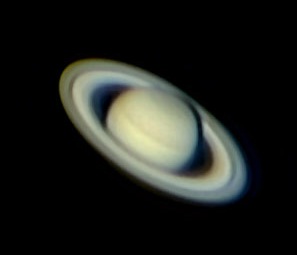
What Can I See with My Telescope: Saturn

Saturn is one of the things in the sky that you can see through a small telescope that is just as impressive as it looks in the photos you see. While many deep sky objects, such as nebulas and galaxies, do not look as impressive as in the books and magazines, Saturn does.

Not only that, there is something special about the way it looks that makes it look different than any photograph or video. When you see it with your eye, it's special. Just like the Grand Canyon, it has to be experienced to be appreciated.

Amateur astrophoto of Saturn by Rochus Hess
Astrophoto of Saturn by amateur Rochus Hess

As I write this, Saturn is a bright star visible in the early evening sky. To find out whether it's visible as you read this, visit one of the free on-line star charts, such as those listed to the right.

What to expect with:

7x35 to 8x65 Binoculars: A bright object that looks somewhat different from a star. It will be steadier than most stars, and a pale yellow in color under most skies. You will also be able to see 2-3 small companions as points of light. One will be brighter than the others. These are satellites of Saturn, the brightest is Titan. Saturn itself will not show a disk with small binoculars, but sometimes it will look misshapen as a result of the rings.

60 to 90mm Telescope: At 50 to 100 powers of magnification, you will have a nice view of Saturn and the area around it. You will probably see 1 to 3 satellites, the brightest of which will be Titan. The rings will be easy to see. At 150 to 200 powers, look for the shadow of the rings on the surface of the planet, under good conditions it will appear as a thin black line. Careful looking with a relaxed eye should show the bands in the atmosphere of Saturn. Some bands will be yellow, others will be white. They will go from side to side across Saturn.

4.5 to 6 inch Telescope: Far more detail will be visible at powers of 150 to 200 times magnification than with a 60-90mm telescope, in most cases. Also, more moons will be visible, as many as five under the best conditions. From brightest to dimmest they will be Titan, Iapetus, Rhea, Dione, and Tethys. Tethys is a difficult find with a 6" scope. Titan will almost always be the brightest when it is seen. Iapetus, Rhea, and Dione are hard to tell apart. There's a Saturn Satellite Finder on Sky and Telescope's site, since you can't tell your moons without a program.

Saturn itself can show a lot of detail. The best way to see it is to stay at moderate magnifications for this scope size (150-200 powers) and look with a relaxed eye. Give yourself time, be seated if possible, and use a scope that tracks the sky with a clock drive or computer if possible. See if you can see the bands within the light bands of Saturn's atmosphere. Enjoy the rings, the break in the rings called the Cassini Division should be obvious with good optics.

7" to 9" Telescope: At this point it's possible for Saturn's features to be washed out by how much light your telescope collects. However, telescopes in this range are excellent for observing Saturn. Start at low powers (50 to 100x) and observe Saturn and its neighborhood, looking for up to 9 moons (see the section on 4.5-6" scopes). Then move up to moderate magnification, about 150 t0 200 powers. At this point you may need to actually block off some of Saturn's light to see fine detail. There are many ways of doing this. My favorite simple methods are to either partially block the light coming in to the telescope with my hand, or do the "hat trick" by blocking some of the light with my hat.

By moving the object you are using to block either more or less light, a little at a time, details can come out for you that would not either without some of the light blocked, or using a light blocker that sits still.

With this size of scope, you can take magnification up to 300 powers or more. Most scopes will give the best views at 350x or less, some can go up to 450x before the image degrades. As the magnification goes higher, the problem of too much light will be less of a problem. However, at higher magnifications you'll need to have some means of tracking the sky, or you won't be able to see much of Saturn before needing to move the scope to follow it across the sky.

Larger Telescopes:

Larger scopes can be used in the same way as 8" telescopes. The only advantage to larger scopes is that they can see more detail within the detail, and can pick more detail out of the rings of Saturn. They are more sensitive to washed-out images of Saturn than scopes in the 7-8" size, but when properly "masked off" they can provide sharp, stunning views. Fine detail that larger scopes can pick up includes "clouds" in the atmosphere of Saturn, streaks in the atmosphere, more detail at the edges of the different bands in the atmosphere, such as swirls, and of course the dimmer inner rings of Saturn. Very well designed scopes of smaller size can pick out these details under excellent viewing conditions, but with a larger scope it's easier to do under less than optimum conditions.
StumbleUpon

Friday, July 11, 2008

Astro Basics

Welcome to Astro Basics! I'm an amateur astronomer with over 40 years of experience. I have been sharing the sky through teaching and telescopes for all that time as well. I regularly take out my telescope to public places to show folks the amazing universe we live in.

When I do this, I get all sorts of questions about the cosmos. Many of them are common questions, some of them are uncommon, but likely to be interesting to anyone who thinks of them or hears them.

I'll be trying to bring some of those things to you here.

If you're interested in information about buying your own telescope, or how to use one you've got, I recommend visiting my other site:First Telescope Guide.
StumbleUpon